Read aloud by your device's own voice, about 16 minutes.
Tokyo, Ryogoku. Sunday 20 September 2026, 12:00 to 18:10. Tour bus from Tokyo Station, home from Ryogoku Station.
Ryogoku Kokugikan: a first day at the sumo, from the bento to the bow
Worth it
Give it the whole afternoon, be inside by one so you can walk the building while it is empty, and stay for the bow at the end.
I had never thought much about sumo. It looked like a funny sport: two very large men, ten seconds, a bow. Then a friend who has followed it for decades got a group of us to the middle Sunday of the September tournament, and I came out six hours later checking wrestlers' records on my phone. This is how the day went, in order, and what I would tell you before you go.
12:00
Tokyo Station
Tickets were the hard part. The official sale for a Sunday had sold out, so one of us found seats through Hato Bus, the Tokyo tour company, which means a package: a ¥5,500 second-floor chair seat, the bus, a bento, yakitori, sweets, a beer and a gift, for ¥20,800. With an ordinary ticket you can be inside from 8:45. With a package you go when the bus goes. Ours left from beside the station at 12:50 under a grey sky and took fifteen minutes.
13:10
The group gate
A separate entrance, a bag handed to each of us at the door, shop staff along the corridor dressed as if it were still the Edo period. The hall holds about eleven thousand, and at one o'clock it was perhaps a tenth full. The lower divisions had been fighting since nine in the morning; the men you have heard of come on at four. Nobody hurries in for the early bouts, which is exactly why one o'clock is the best time to walk the building.
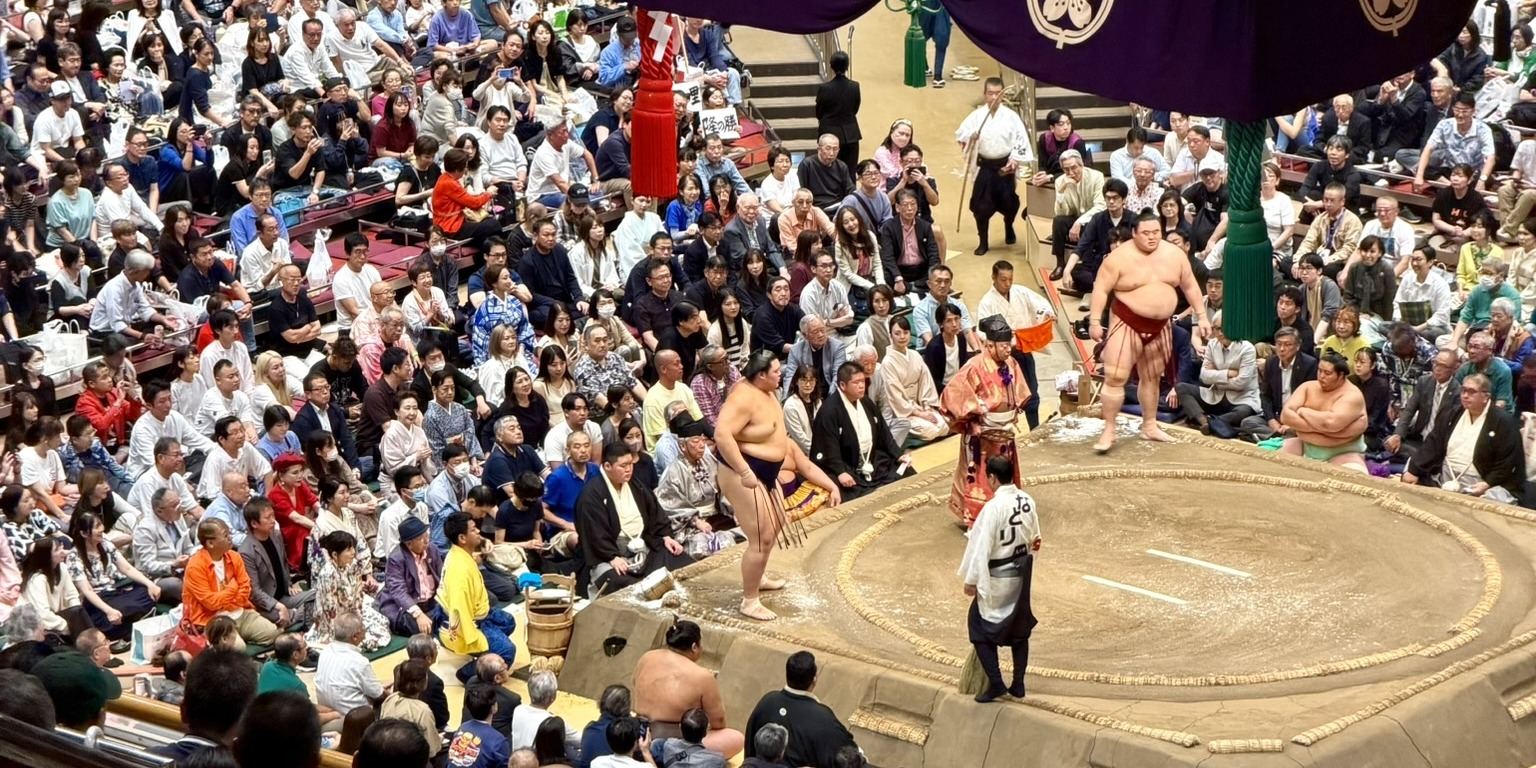
The hall, simplified. Second-floor chairs run all the way round, box seats fill the four sides below them, ringside in front of those, the ring in the middle. For a first visit, east or west second-floor chairs are the sensible buy: a chair, a view of both wrestlers, and about half the per-person price of a box.
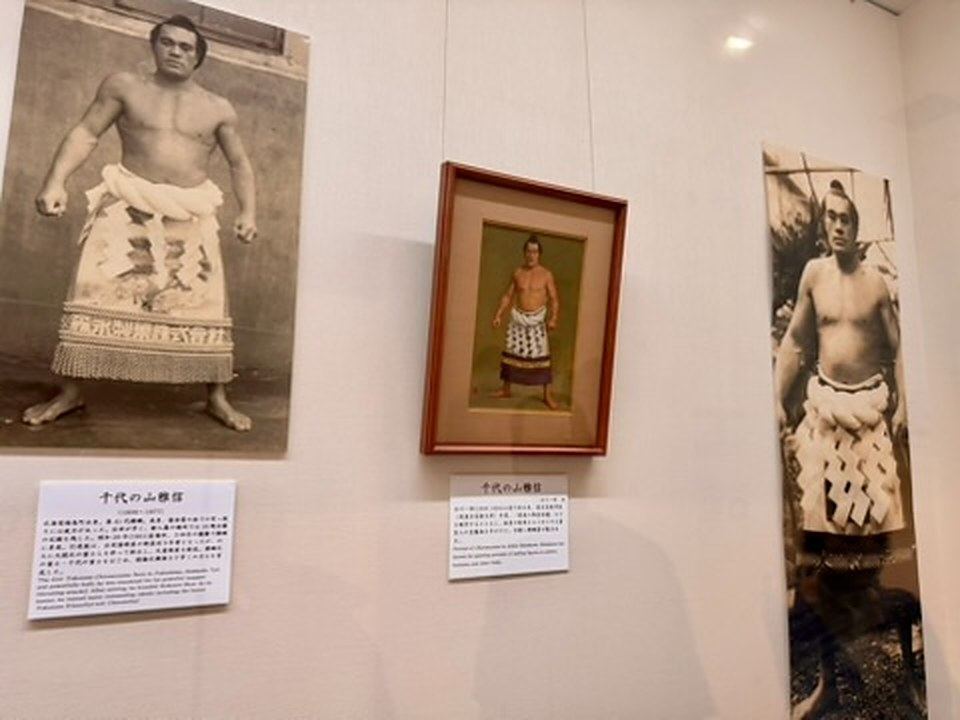
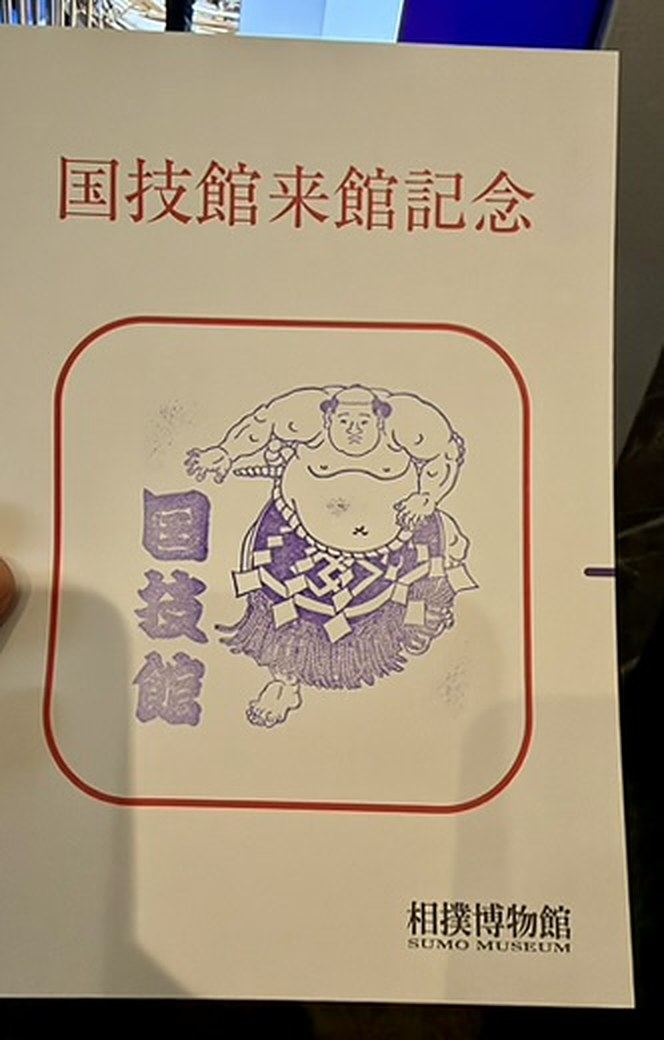
Sumo Museum, first floor, off the entrance hall. Spectators only during a tournament; the stamp is free.
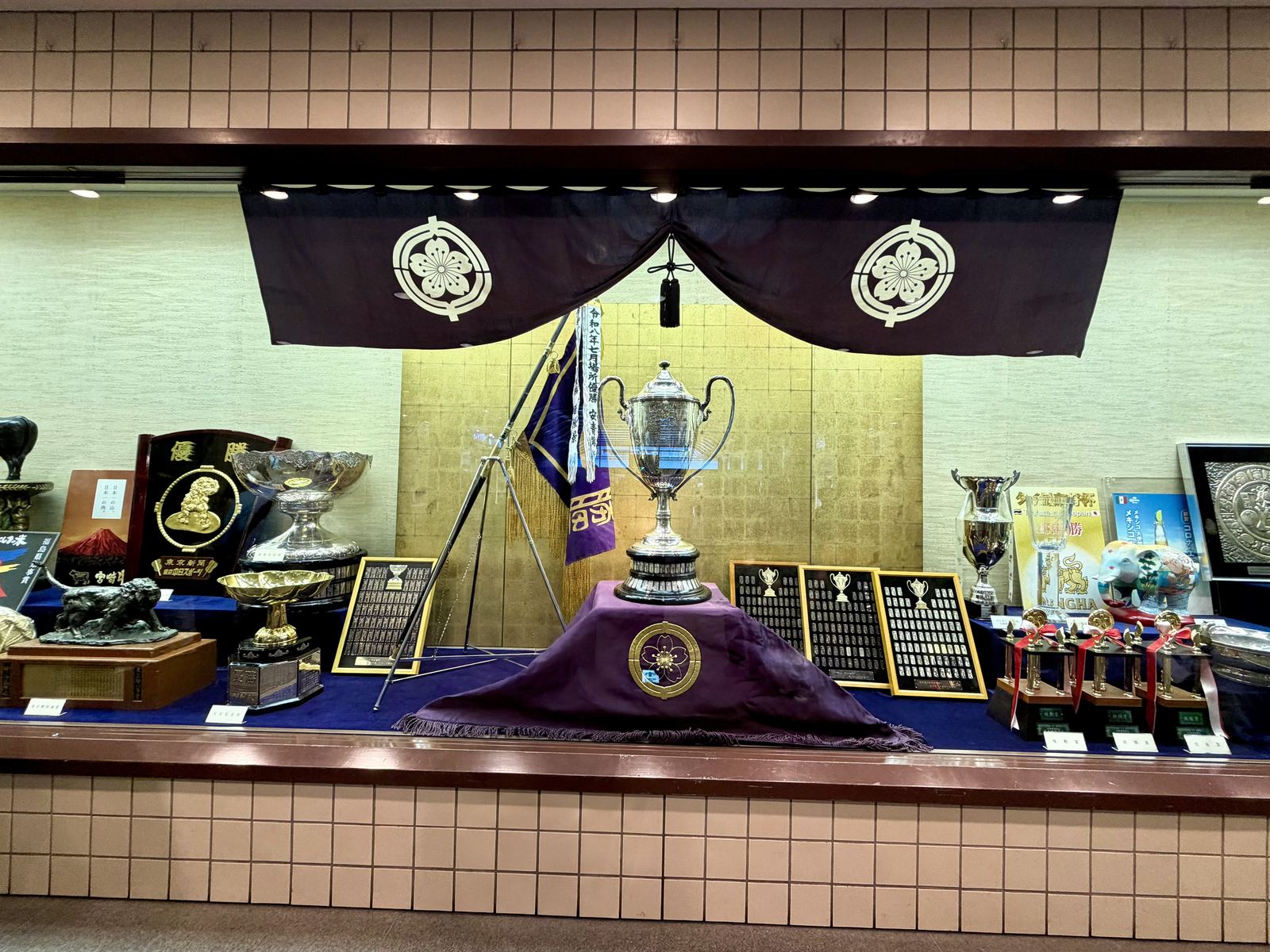
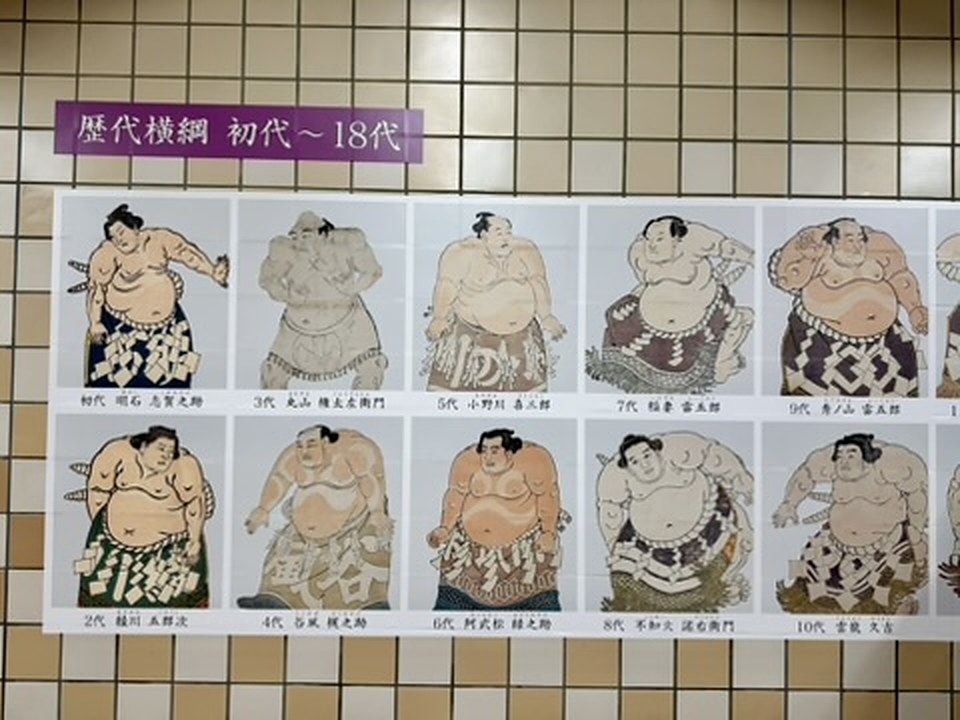
The corridors: the trophy case, the yokozuna prints, the life-size boards.
Where we sat: second-floor chairs, east, row 10.
The chanko hall, in the basement under the entrance hall.
The royal box, main side, second floor.
13:22
The corridors and the Sumo Museum
Two things come free with the ticket that most people skip. The museum on the first floor, which during a tournament only spectators can enter, and the walls of the building itself: old trophies in glass cases, the successive yokozuna as woodblock prints from the days before cameras, then photographs once cameras arrived, and high around the hall the framed portraits of tournament winners. The museum itself has the old ceremonial aprons, the wrestlers' handprints pressed onto paper, and photographs going back to the 1980s and long before. Along the corridors there are life-size boards of old wrestlers you can stand beside for a photo; we did, and then took the obligatory selfies from every angle of the hall while it was still empty. The museum also has a stamp you press onto a sheet of paper. Mine is on a wall at home now.
The trophy case in the first-floor corridor: the Emperor's Cup in the middle. This is what the tournament winner lifts on the final Sunday; the flag beside it goes home with him too.The first eighteen yokozuna, as prints. Cameras came later; for the early ones this is all there is.The museum's photographs: the yokozuna Chiyonoyama, 1950s. Once cameras arrived, every yokozuna is on a wall like this.
The stalls sell Kokugikan curry, motsunabe and chanko: what the wrestlers eat, sold to the people who came to watch them. Our friend explained the eating itself: no breakfast, training on an empty stomach, then chanko, the stew, which is also served in the big hall in the basement. We skipped it, saving ourselves for a chanko restaurant near the hall later.
The museum stamp. Free, at the museum desk, on a sheet they give you.
13:51
Back in the seats: the bag
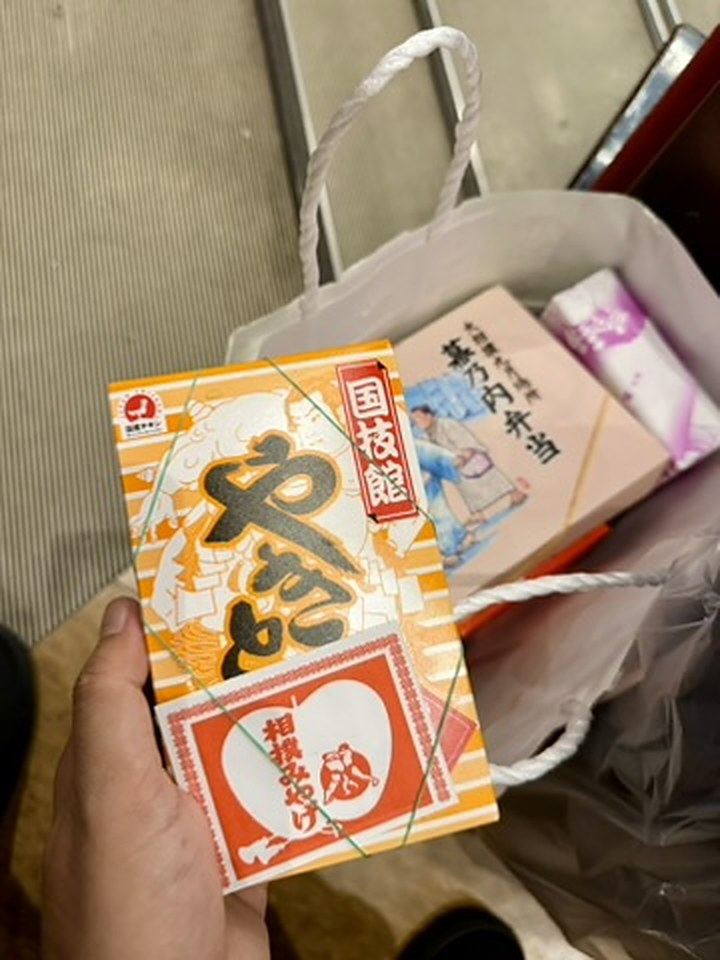
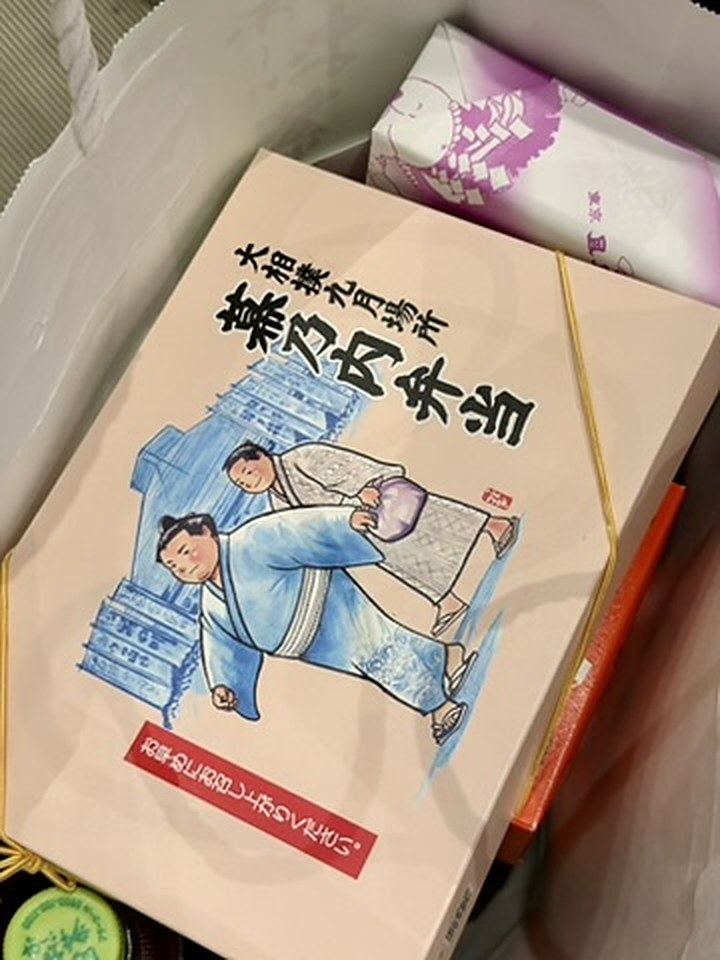
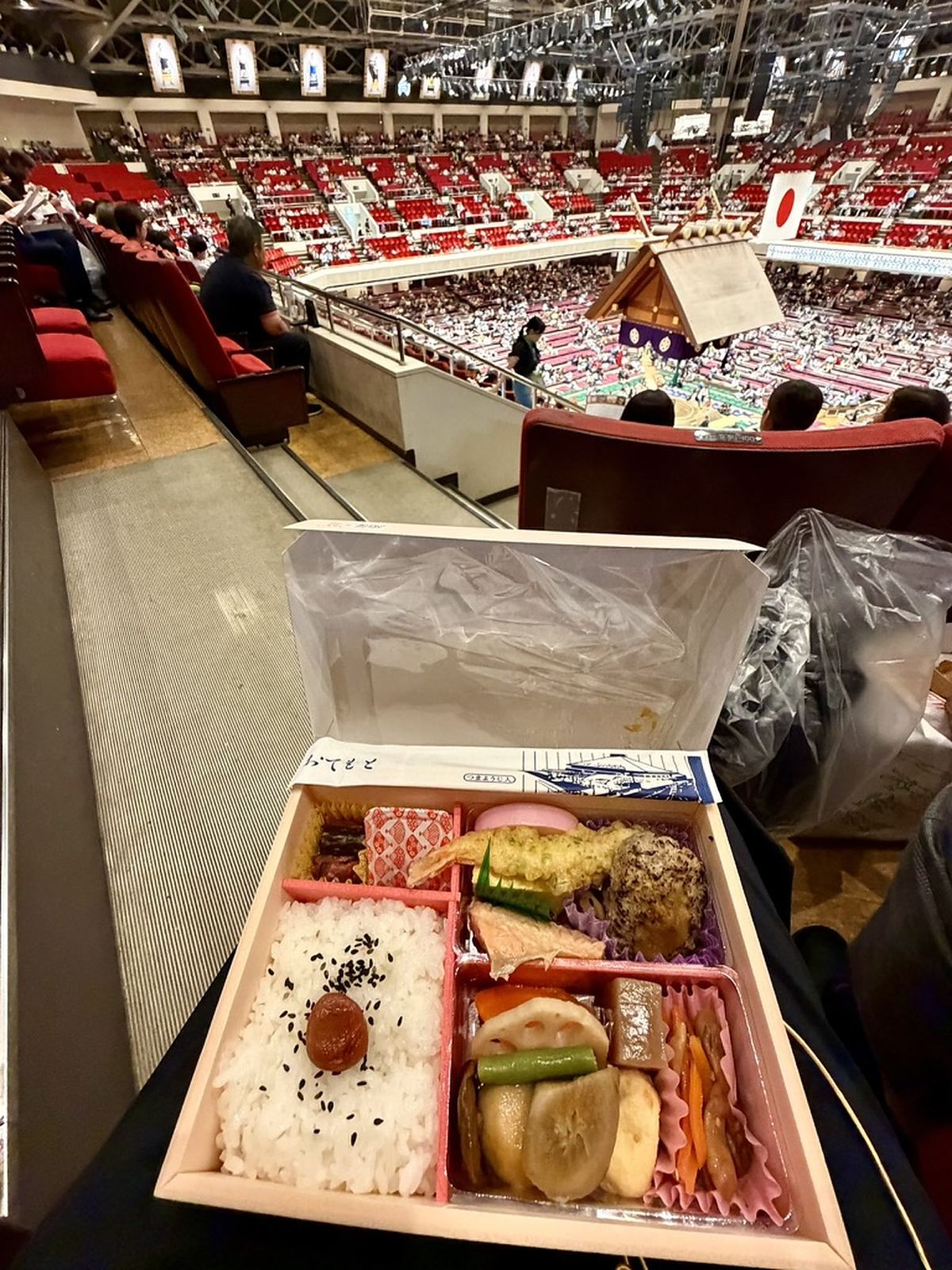
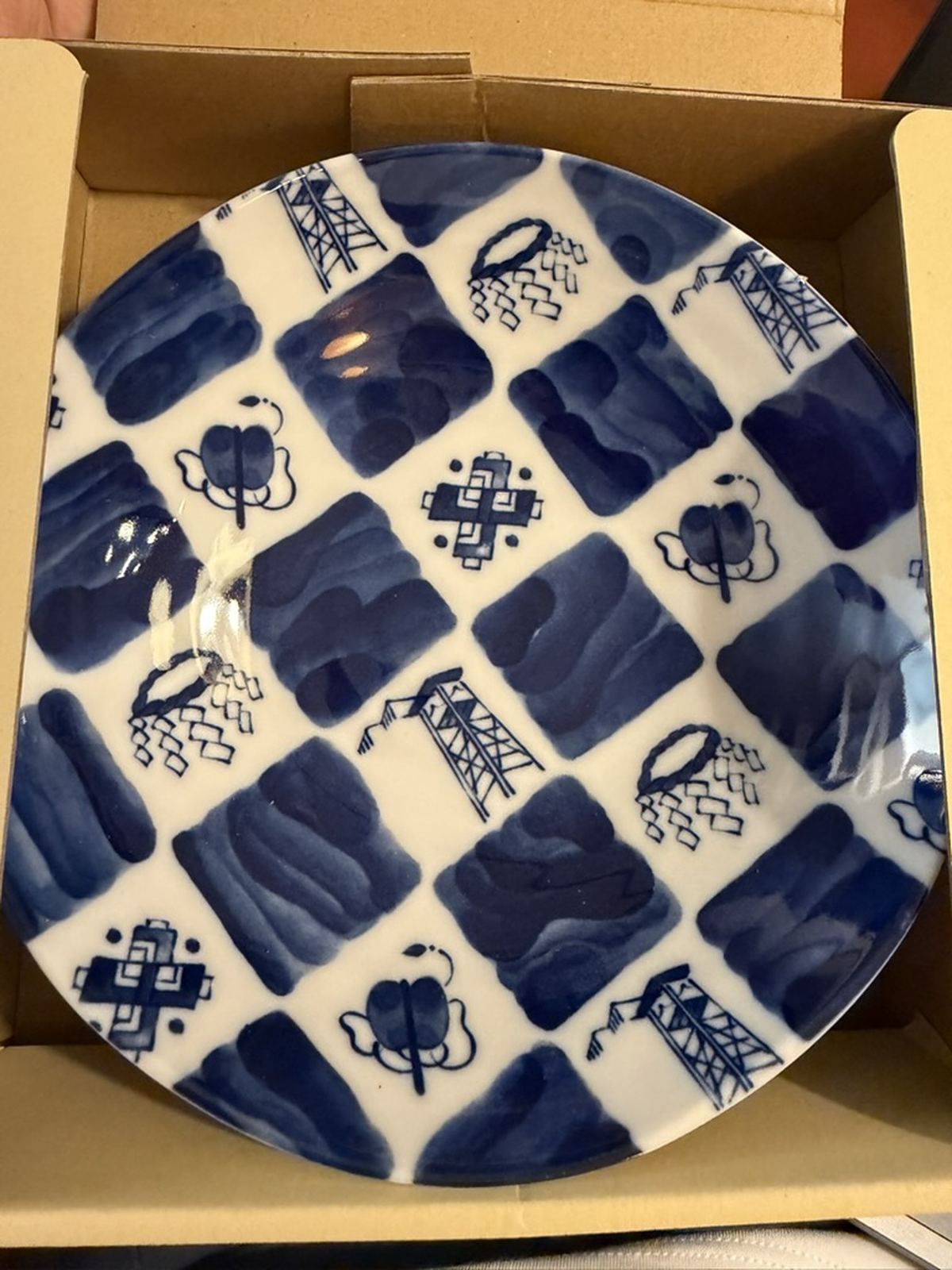
We were hungry, so the bag came open: a box of the yakitori that is grilled in the building every day, a makunouchi bento with a wrestler drawn on the lid (tempura, rice, umeboshi, the standard things done properly), sweets, a can of beer each, and at the bottom of the bag the gift, a blue and white plate with sumo motifs on it. Kanpai, then lunch with the lower divisions fighting in front of us, which turns out to be the correct way to watch them.
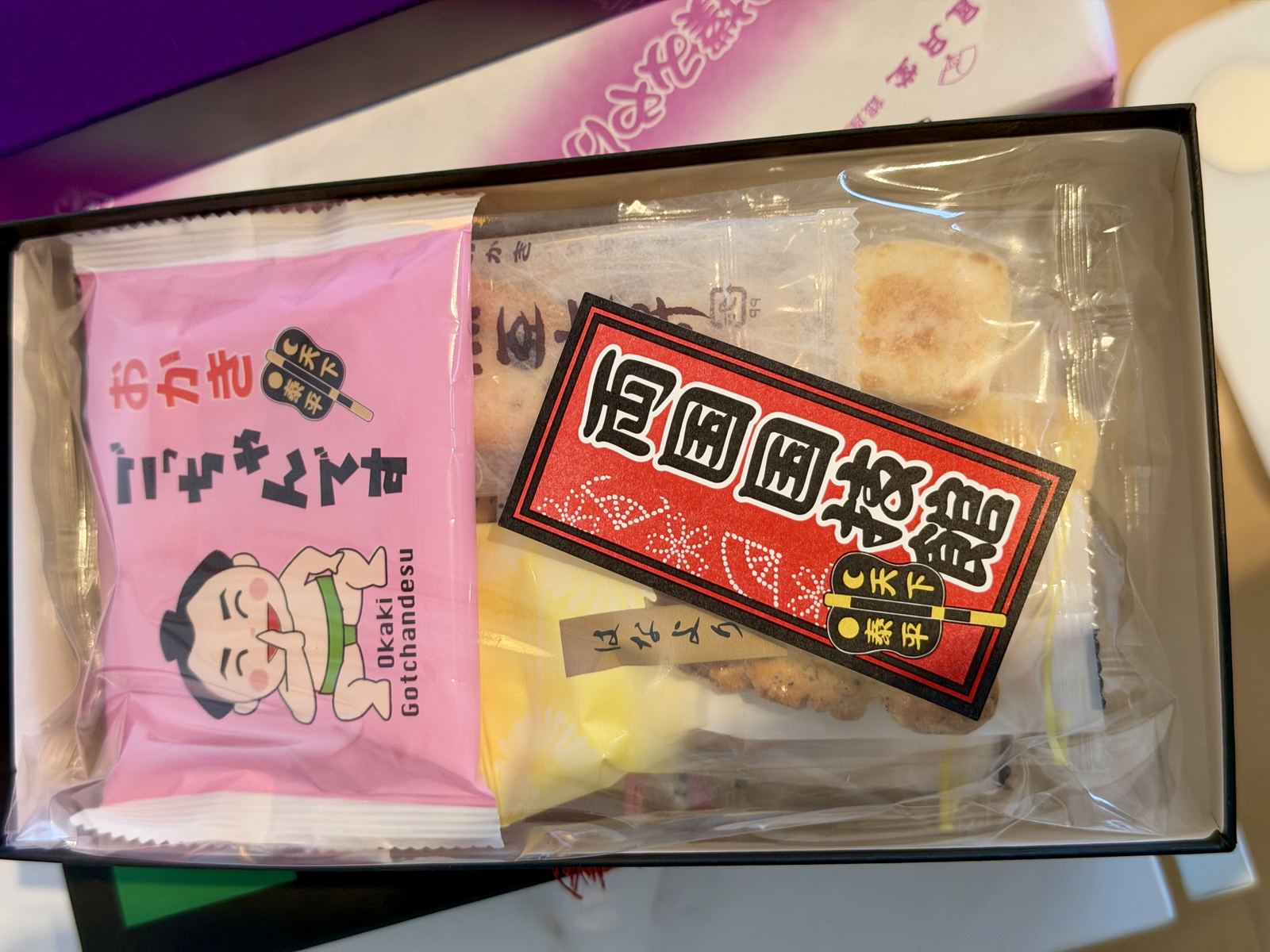
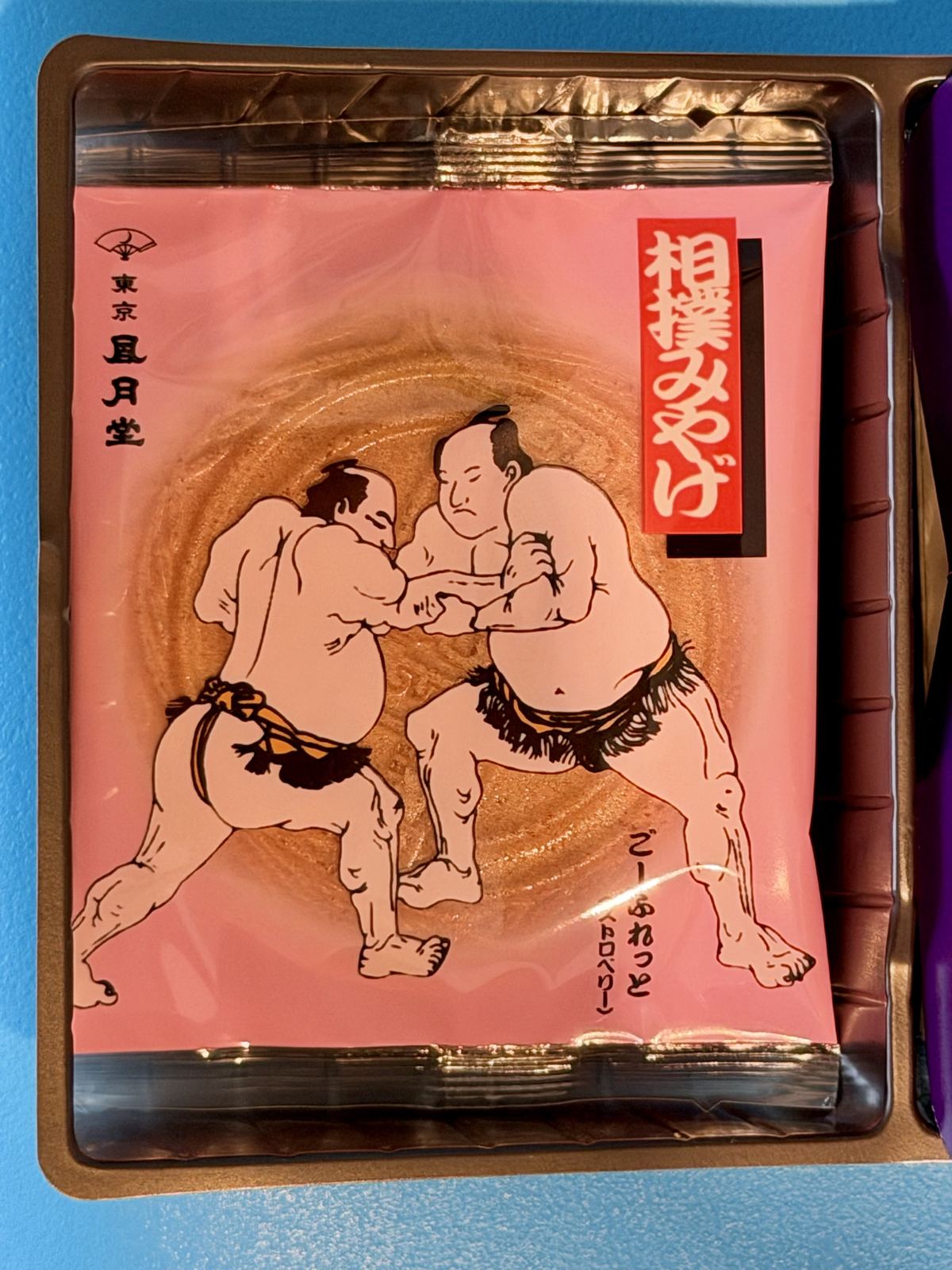
The Kokugikan yakitori, first out of the bag. Grilled in the building every day. It comes cold, and that is how it is meant to be eaten.The tour bento, second floor east. Every wrestler-branded lunch in the building looks like this; they are all fine.The bento open, the ring three rows below. Rice with an umeboshi, tempura, salmon, lotus root, simmered vegetables. Eat it during the lower divisions, not the top ones.The gift from the bag, opened at home. A blue and white plate with sumo motifs, the drum tower among them. It is why the package price makes more sense than it first looks.The sweets from the bag, opened at home. Rice crackers in the Kokugikan's own box; each little packet says gottsuan desu, the wrestlers' thank-you.A strawberry gaufrette from Tokyo Fugetsudo, in sumo wrapping. The bag turned out to be a small souvenir shop on its own.
15:31
The day's card
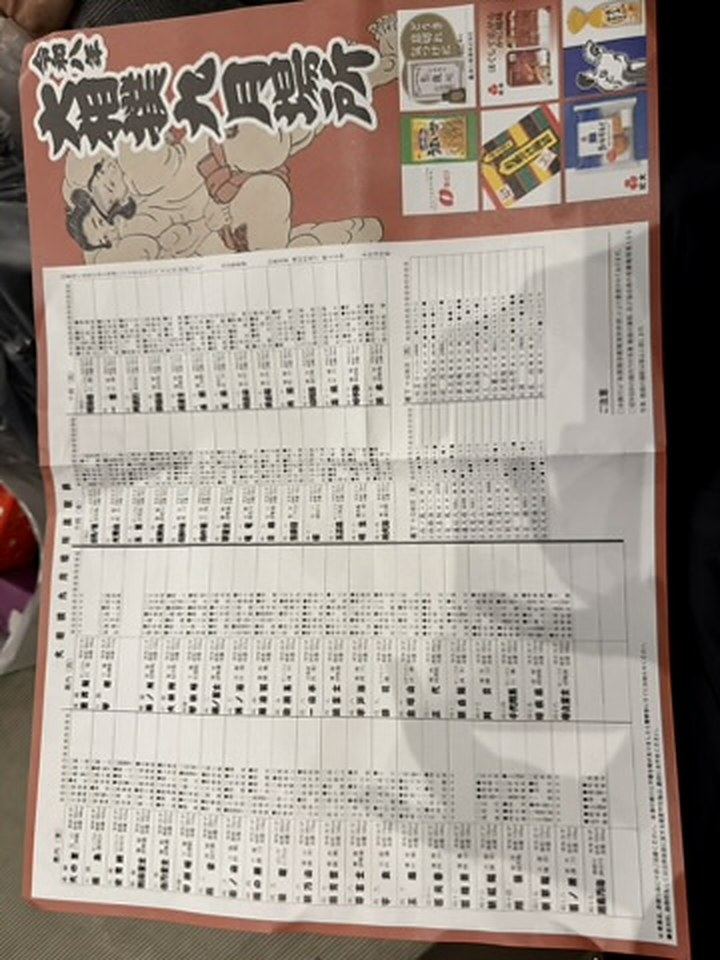
A printed sheet of the day's bouts, east against west, with ranks and records. We used it alongside the association's website, which updates as the results come in.
The bout sheet, on a knee. Even if you cannot read it, the English version of the website lists the same bouts in the same order.
15:35
The judges walk in
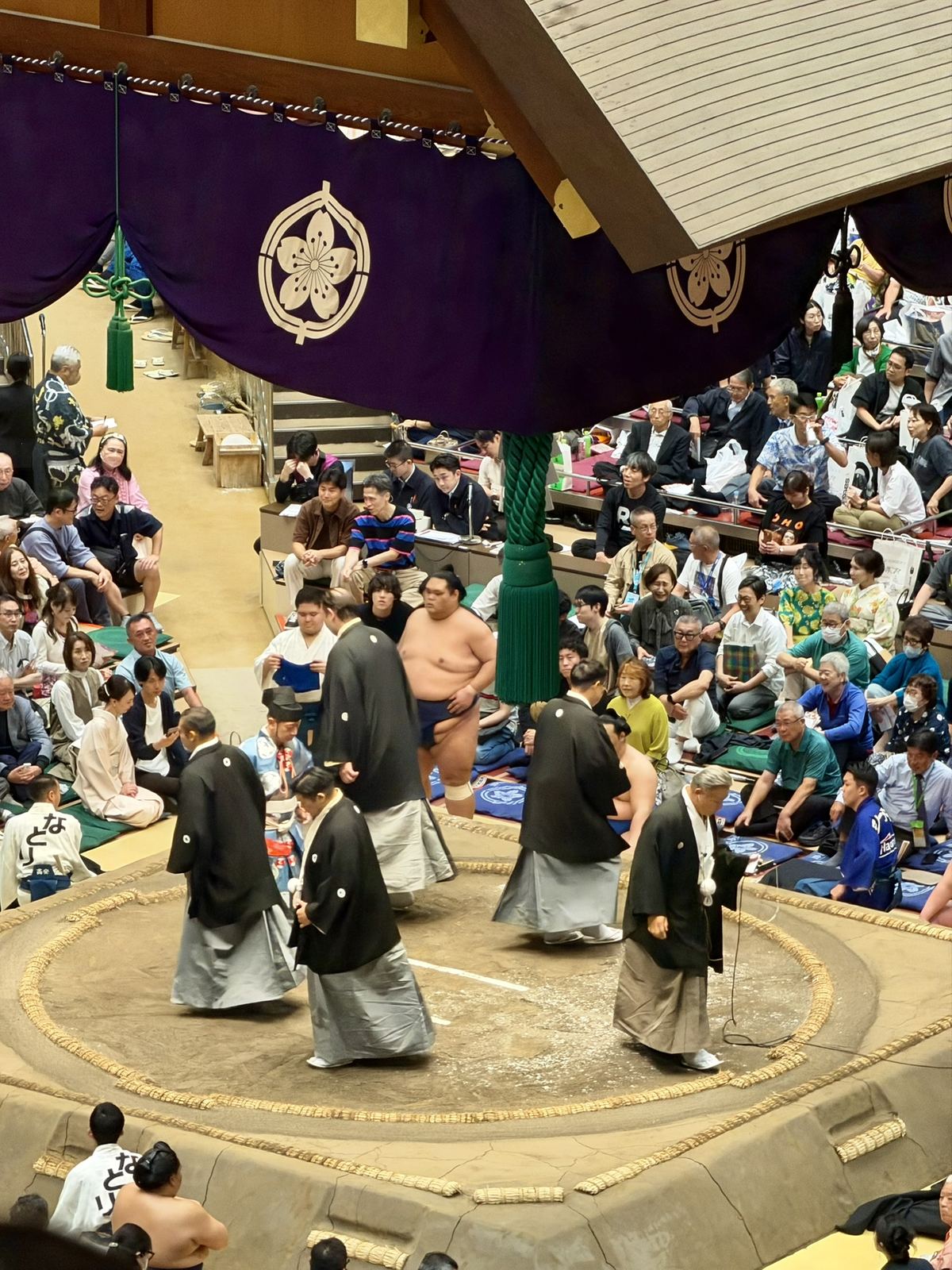
Before the top division there is a changing of the guard: the judges in black kimono walk across the ring to their places around it. There are five. When the referee's decision is doubted, they climb into the ring and confer, and the hall goes quiet for it.
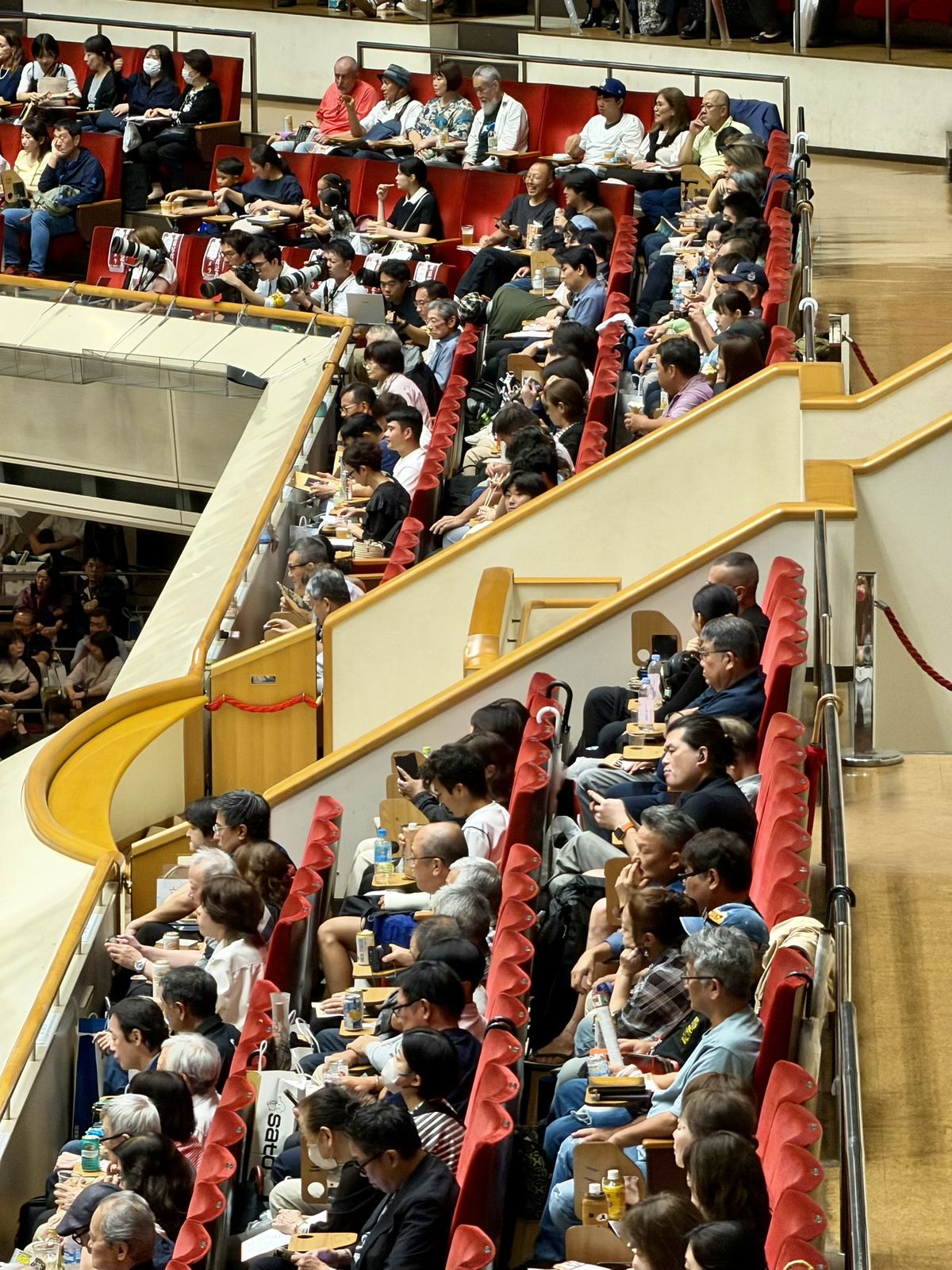
Second floor east, row 10. The phone's 4x reaches the ring from here; you do not need the long lenses the row in front had.
15:50
The ring-entering ceremony
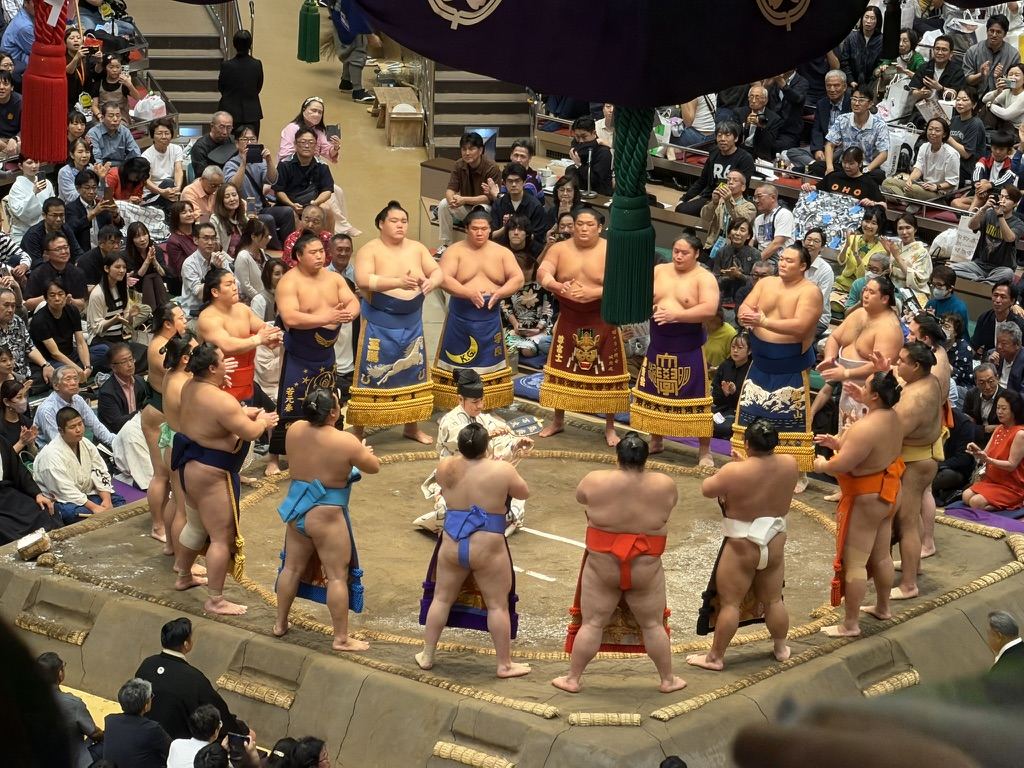
The top-division wrestlers come out in two groups, east then west, in their decorated aprons, form a circle, clap, lift the aprons an inch and file out. Then the yokozuna does his own, alone with two attendants. There are rarely more than two yokozuna; you get there by winning tournaments back to back, and you cannot be demoted, so when a yokozuna stops winning he retires. This month there was only one in the building, Onosato, because Hoshoryu had withdrawn, so every eye was on him.
The makuuchi ring-entering ceremony. Be in your seat for this; it is the one moment half the division is in the ring at once.
16:00
The bouts begin
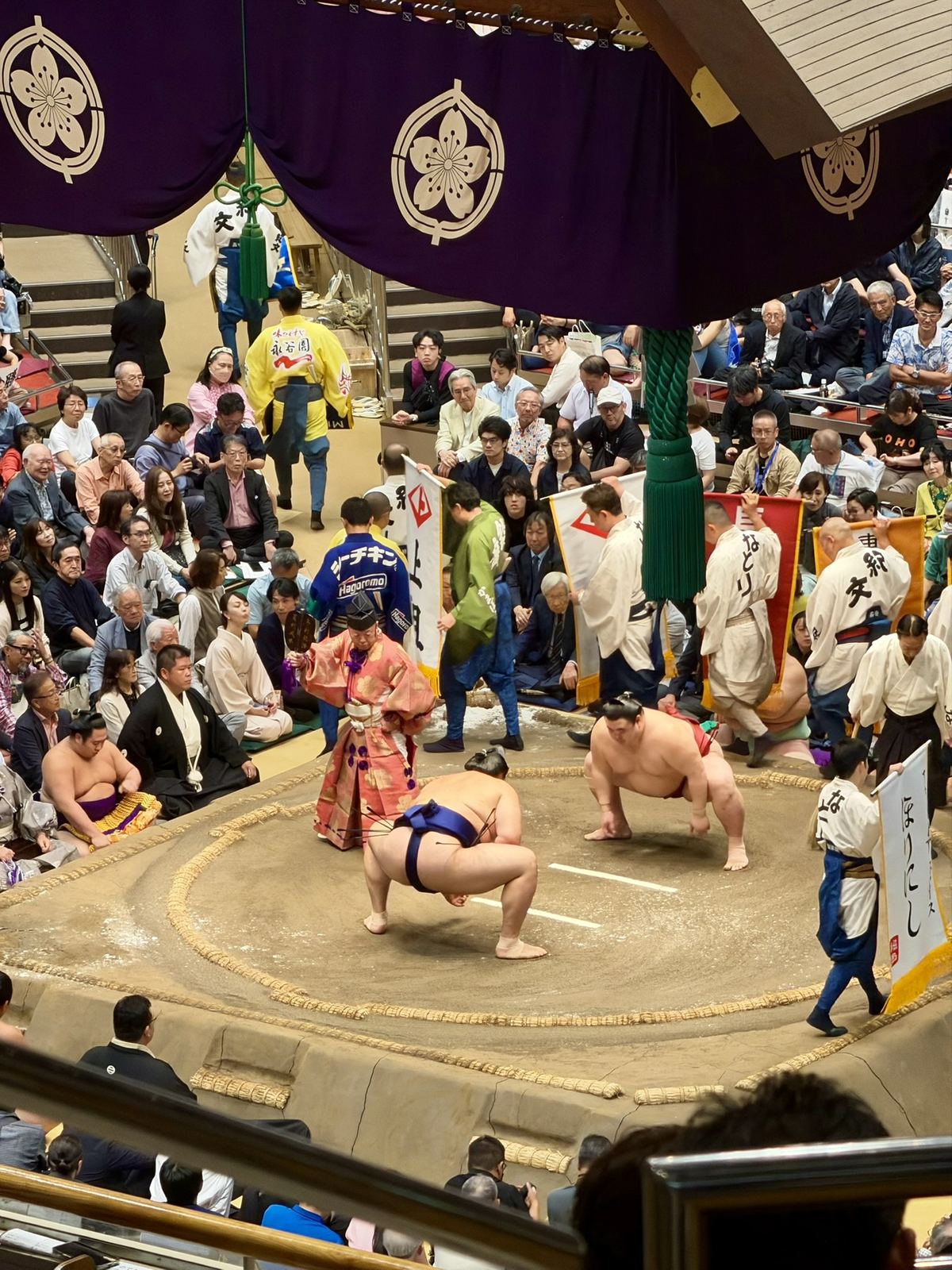
The screen above the ring shows who is fighting, people around us shout the names, and it goes fast: ten seconds of impact after minutes of ritual. We followed on the association's website, which has an English version and gives each man's record so far. Our friend pointed out the box kept for the emperor, with the flag above it, and then the nationalities: Mongolia everywhere, a Russian, and a Ukrainian ozeki, Aonishiki, who won his first title last November, the first Ukrainian to do it, and two more this year. My idea that sumo was a Japanese-only sport lasted about an hour.
Second floor east, looking along the row. The upper rows fill after four; before that the chair seats are half empty.
17:07
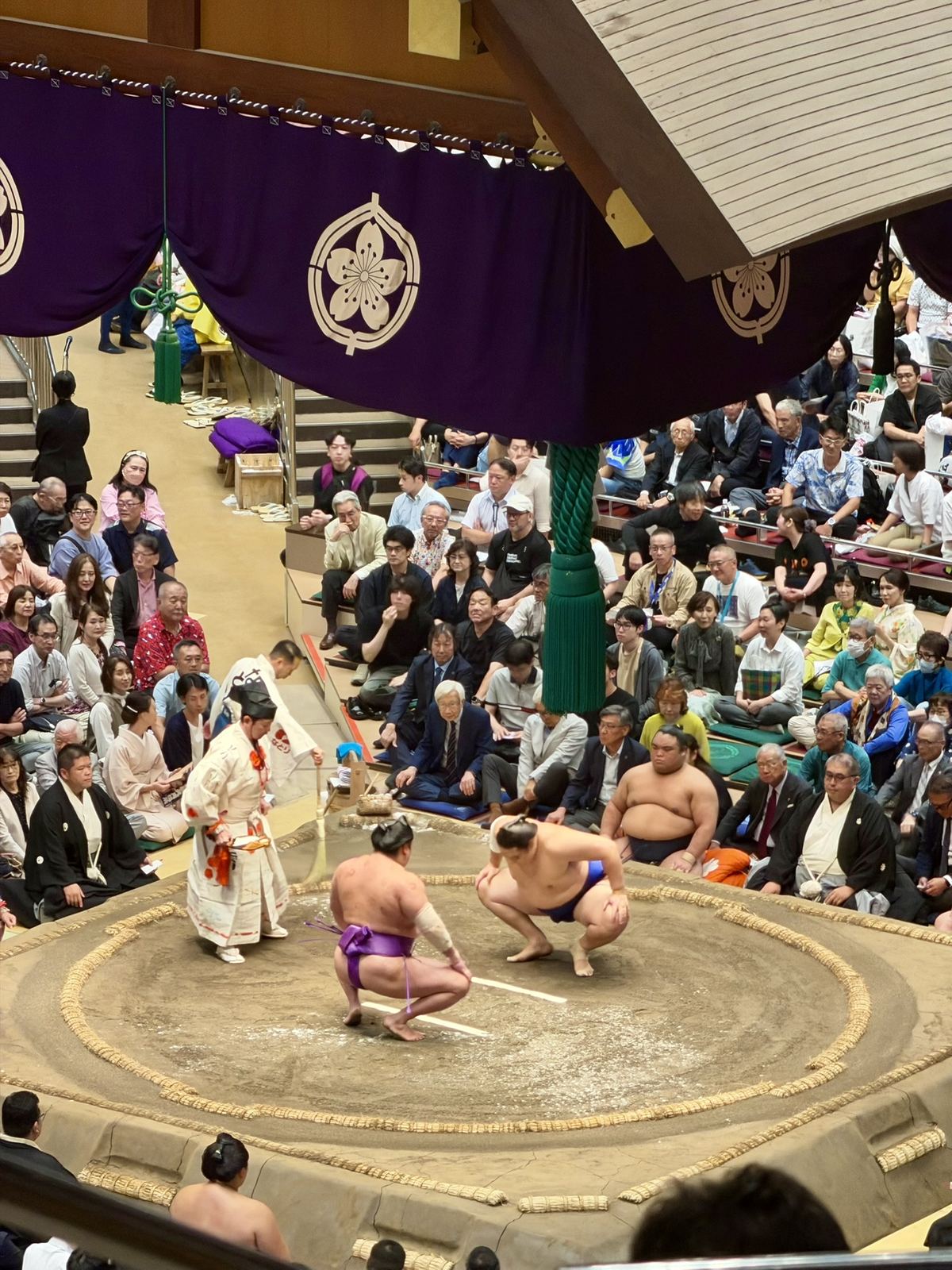
The ritual before every bout
They crouch, stare, throw salt, stand up and go back to the corner, rinse their mouths with water handed to them by the previous winner, wipe with a paper, and come back. Two or three times. The top division has four minutes for this and uses all of it. Then the clash, and it is over before you have decided who to watch. The referees change with the rank of the bout, and our friend pointed at the last ones: the two most senior carry a short dagger, a sign that in the old days a wrong decision meant taking responsibility with it.
The crouch, from the second floor. Shoot the stare, not the clash; the clash is two frames and you will miss it.
17:52
The banners
Before the big bouts, men walk around the ring carrying sponsors' banners while the announcer reads the company names. Each banner costs the sponsor ¥70,000. The winner's share is ¥60,000, although only ¥10,000 of it is in the envelope he takes from the referee's fan; the rest goes to his account and to a reserve he gets when he retires. A yokozuna bout can carry forty or more, so a single win is around 240万円, that is ¥2,400,000, before tax.
The banners for the last bout. Count them; the number tells you how big the bout is before the announcer does.
17:53
The last bout
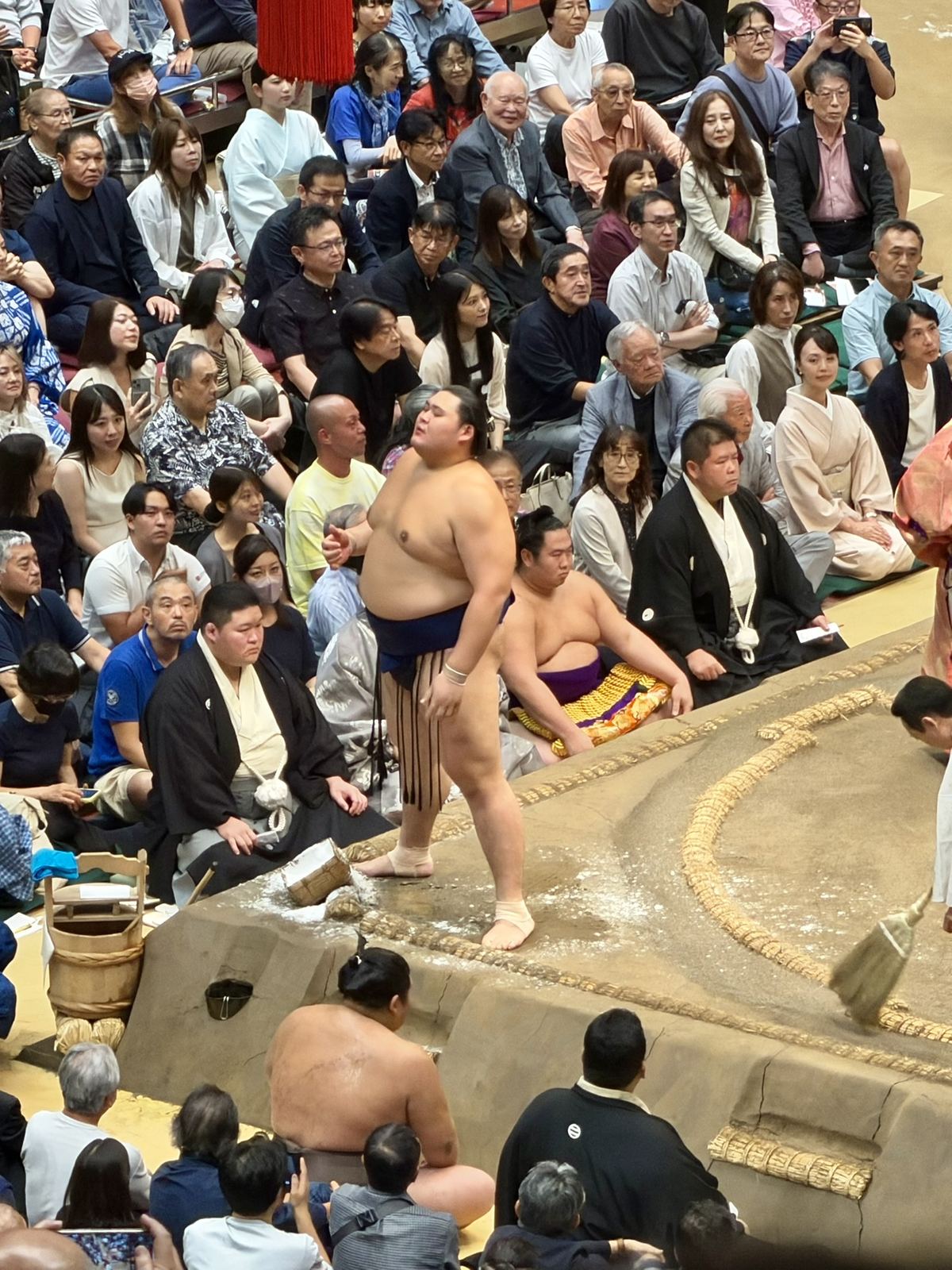
The yokozuna fights last. Onosato, against Takanosho, and he won, which left him at seven wins and one loss at the halfway point of the tournament. He looked different from everyone before him: taller, and every part of the body looked as if it was used for something. What you notice from the second floor is the bodies. The ones who look fat from behind are not; there is a lot of muscle under it. Small ones beat big ones often enough that it is clearly technique. And after an hour I could guess from behind who would lose: the disproportionate ones, big above and thin below, lost their balance first.
The corner with the salt basket, east side. The judge in black at the corner is who you look at when a decision is disputed.
17:55
The bow
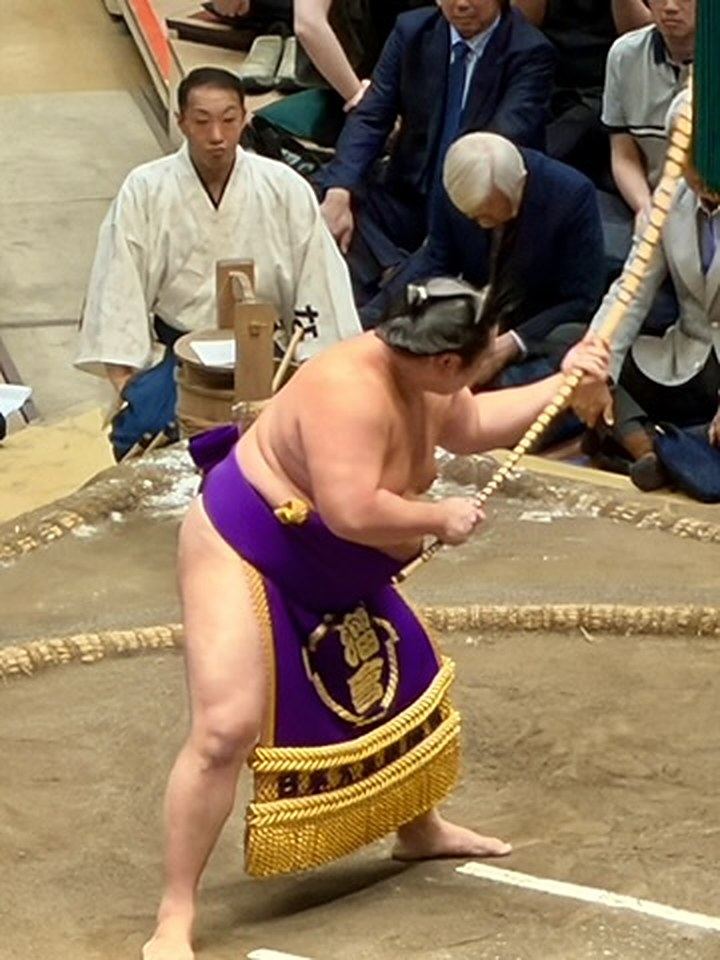
After the last bout a lower-ranked wrestler twirls a bow in the ring, the ceremony that closes every day. Most people are already on the stairs. Stay. It is two minutes and it is the quietest the hall gets.
The bow-twirling ceremony. From the second floor the bow is long enough to read; from the first, people are standing.
18:10
Out through the shops, then the train home
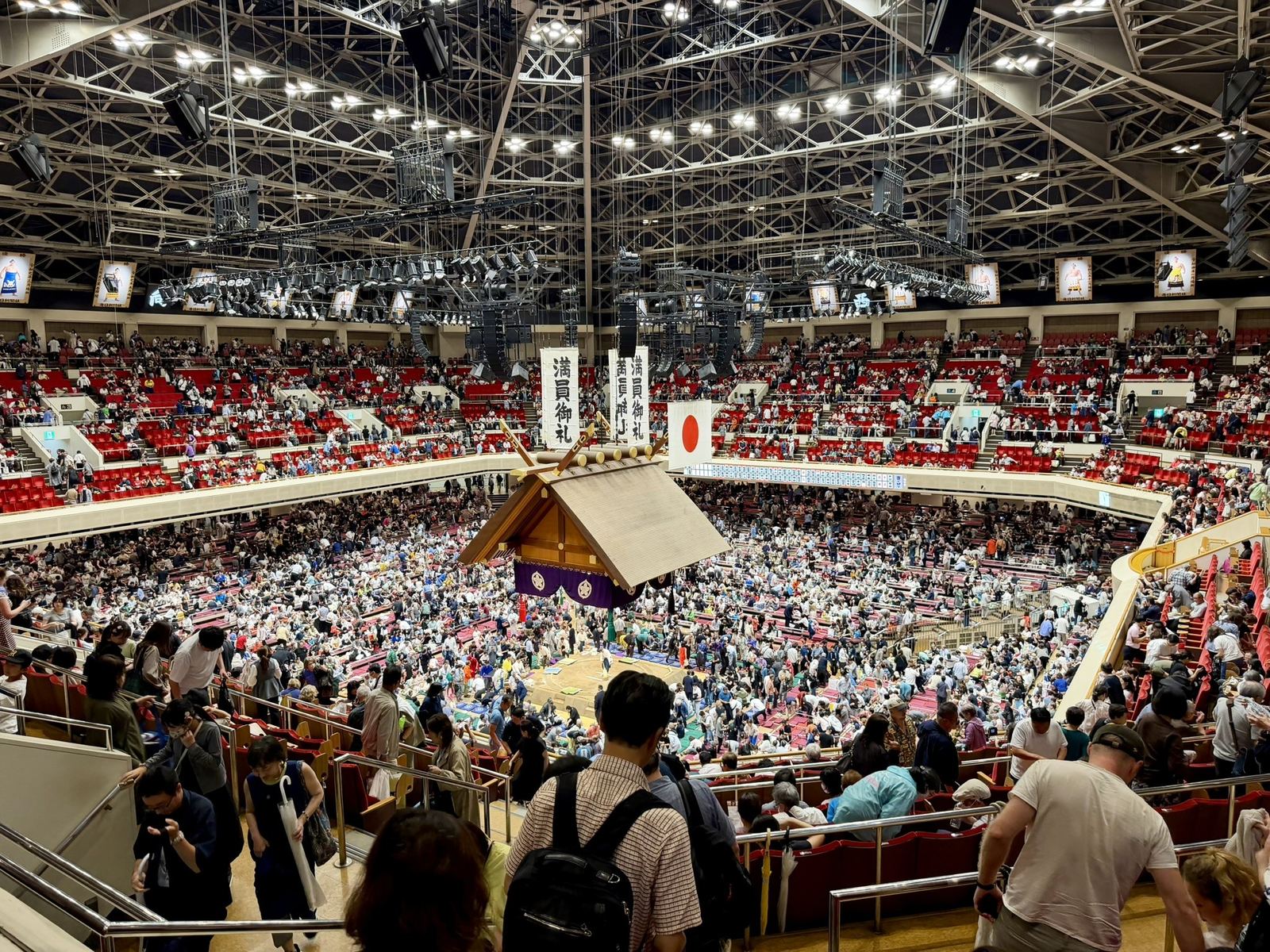
The full-house banners were still hanging over the ring as we left. A stop at the shops for gifts, then Ryogoku Station, five minutes' walk, Sobu Line or Oedo Line.
Leaving, from the top of the second floor. The white banners over the ring read 満員御礼, full house, thank you. They go up whenever the day sells out.
Clips from the day
First clip, on YouTube. Tap to play; nothing loads until you do.
Before this day I had never thought about sumo for more than a minute. There is wrestling, there is karate, there is boxing, and I had filed sumo somewhere near the comedy end of that list: two very large men in a ring for ten seconds. I would not have crossed the street for it.
What turned it around was a conversation with our friend halfway through the afternoon. I asked him how long these men live. The commonly quoted figures put the average around sixty; he said fifty or sixty, seventy at most, which is roughly the same answer. Every wrestler in that hall knows this and chooses the profession anyway. He then has to build that body on purpose, and our friend said it does not go away: they lose some weight after retiring, but the frame stays for the rest of their lives. Choosing a career you know will shorten your life, and remaking your body for it, is a level of seriousness I had never connected with anything I would have called a funny sport.
The second thing was watching the bodies work. From behind, many of them look simply fat. They are not; the fat sits over a great deal of muscle, and it is the small men who make this obvious, because they beat the big ones often enough that it cannot be luck. By the last hour I could call the loser from the back: the disproportionate bodies, big above and thin below, lose their balance first. The yokozuna, who fights last, looked like a different species. Taller, and every part of him looked as if it was used for something.
The third thing was the rules around the top. There are rarely more than two yokozuna at once. You get there by winning tournaments back to back, the rank cannot be taken away, and so the only way down is retirement; a yokozuna who stops winning is expected to go. Below him is a ladder of ranks, redrawn after every tournament from each man's wins and losses, so every bout on the sheet moves someone up or down. The referees who judge the last bouts carry a short dagger, a reminder of the days when a wrong decision was a matter of honour. The five judges around the ring climb in and argue it out when they doubt a call. The banners, the salt, the water, the four minutes of staring: none of it is decoration. All of it is the sport taking itself seriously.
And the danger is real, if rare. People do not die in the ring often; the last case I found was a lower-division wrestler in 2021 who landed on his head and died a month later. Everyone who steps up there knows that too.
So it is not a funny sport. It is one of the most serious things I have watched, in a building where everyone from the man selling curry to the referee with the dagger behaves as if it matters. I came home and started following the wrestlers on Instagram that night, and checking the results of a tournament I had not known was on.
Before you go
Getting there
Ryogoku Station (JR Sobu Line local, or Toei Oedo Line) is outside the door. From Tokyo Station about 15 minutes with one change at Akihabara. The Hato Bus was part of the package, not something you need.
Tickets
Official sales open about a month before the tournament and weekend seats go fast. A second-floor chair seat is ¥5,500 at face value. When the official sale is gone, the Hato Bus package at ¥20,800 (seat, bus from Tokyo Station, bento, yakitori, sweets, a beer, a gift) is the fallback, and how we got in.
The day
Doors 8:45 on our day. Bouts from about 9:00. Juryo ring-entering about 14:15, top-division and yokozuna ring-entering about 15:40, top-division bouts from about 16:00, bow ceremony about 18:00. Arrive by 13:00 to see the building empty; be seated by 15:40.
Inside
Sumo Museum on the first floor, free, spectators only during tournaments. Chanko in the basement hall, yakitori and curry on the stands, beer everywhere. No need for a conbini stop. A phone with a 4x lens covers the ring from the second floor.
Cost for the day
¥20,800 for the package, plus whatever you buy in the shops. About ¥7,000 with a face-value ticket and food bought inside.
Visited
20 September 2026, day 8 of the September tournament. Prices and times checked on that date.
Combine it with
Chanko in Ryogoku. The restaurants around the hall, several run by former wrestlers, serve the stew the wrestlers eat. On tournament days they fill from 18:00; go straight from the bow ceremony or book.
Kyu-Yasuda Garden. Two minutes from the hall, free, a small Edo-period stroll garden around a pond. Do it in the morning before the doors open, not after, when it is closing.
 Between Stations